the not-so-parallel Gospels
- Mar 19, 2011
- 6 min read
Updated: Mar 25, 2023
A parallel version of the gospels shows how each writer recorded the life and teachings of Jesus. It's interesting to see the similarities... and the differences.

the balcony to an old apartment overlooking the walking street in Oradea
The typical way of arranging gospels in parallel is chronologically. Using the time stamps and similarities in each gospel, you stretch and rearrange until you have most of the verses aligned.
It's not easy, but it is much more simple to align only Matthew, Mark, and Luke: the Synoptic Gospels. Adding John into the list will surprise and frustrate you.
It is common to explain that Matthew, Mark, and Luke were written to give a first-hand account of the life of Christ and John was written as more of a teaching book: an epistle arranged according to the life of Christ. That may be, but the most striking difference between John and the other writers is that they were all dead by the time he wrote. By the time John wrote there was also no Temple, no Jerusalem, and no Israel. 20 years prior to John putting pen to papyrus the Jews had revolted against Rome, Rome squashed the revolt, then everything else for good measure. Israel was destroyed and remained destroyed until after World War II: May 14, 1948 to be exact.
Matthew, Mark, and Luke wrote to a new Church that was excited to hear how their Lord lived and what he said. John wrote to a Church that had expected the return of Christ, then hoped for it, and then was wondering what had happened. Christ was supposed to return in glory and set up his kingdom. Now there was no Israel. And worse, there was no Christ.
John's Gospel is different. Matthew, Mark, and Luke are filled with announcements, excitement, and warnings of the coming kingdom. The people were called to prepare themselves and were warned what would happen if they didn't.
On the one hand, John's Gospel being written after the destruction of Israel must be different from writings that came before. It would be astonishing if it weren't different. But it is not just different. It is really different.
There is no coming kingdom in John's Gospel, no call to repentance ("repent for the kingdom of God is at hand"), no institution of the Lord's Supper ("I will not drink of this fruit of the vine until that day when I drink it new with you in my Father’s kingdom”) and the washing of feet instead ("I have set you an example, that you also should do as I have done to you"). There are no parables (“The kingdom of heaven is like treasure hidden in a field"), no Beatitudes (" “Blessed are the poor in spirit, for theirs is the kingdom of heaven"), no Lord's Prayer ("thy kingdom come"), and no Transfiguration ("there are some standing here who will not taste death before they see the kingdom of God”). John's Gospel is not just after the destruction of the Temple; it is after the destruction of their hopes. John does not look forward to a kingdom that did not come.
John's Gospel (for whatever reason) also does not record the baptism of Jesus, his temptation in the wilderness, his prayer at Gethsemane, or the Great Commission. Miracles are few and are not miracles per se: they are signs, always with an accompanying call to belief or statement of belief. There are no exorcisms. John the Baptist does not ask Jesus if he is the one but instead announces confidently that Jesus is. There is a constant mentioning of the Spirit that does not exist in the Synoptic Gospels. Conversely, references to unclean spirits found in the Synoptics do not occur in John. Not surprisingly, John's Gospel leaves out the request for James and John to sit on the left and right of Jesus in his kingdom.
John includes many events and teachings that are not found in the Synoptics, but one in particular is noteworthy: the raising of Lazarus. This was the last straw for the enemies of Jesus: from that point they determined to kill him. It is remarkable that this decisive moment, this point of no return, was not recorded by any of the other writers—and also that the raising of Lazarus, the brother of Mary and Martha, was not mentioned by any of them: even though they considered going to Bethany so perilous that Thomas remarked, "“Let us also go, that we may die with him.”
back to the point...
Because the Synoptic Gospels were written alongside the other writings in the New Testament (except John's Gospel and epistles and the Apocalypse) the books form a dependency. There are numerous references (almost exact parallels at times) between the three gospels, and many references from the three gospels to the other letters, and vice versa: not necessarily quoting from one author to another, but a common theme. John's writings stand alone. An island with barely any of the other writings in sight. When there is a commonality between John's gospel and the rest of the New testament, it is to his other writings, or recalling something that the other gospel writers also wrote down, because he was there with them after all.
Below are charts showing the strength of references to each gospel. The darker the color, the greater the "piling on" of references. Sometimes the references are parallels, as in the feeding of the 5000. Sometimes they are close companions, as in the feeding of the 4000 to the feeding of the 5000, or Jesus calming the sea while asleep in the boat and also calming the sea after he got into the boat.
Sometimes they are similar teachings, such as Christ dying on the cross, which is found in many other writings of the New Testament. And sometimes they are "also see" references that point to a common theme or an interesting side note, such as the angel in dazzling white at the tomb referencing Dan 7:9 where the clothing of the Ancient of Days is white as snow. Not the same thing, but nice to know.
The result is this:

The difference between the Synoptics and John is striking. Matthew and Mark especially have strong similarities to one another. The middle section of Luke is light because chapters 14-17 are Jesus' parables and warnings about the coming kingdom that are largely unique to Luke.
But: John has almost no similarity to the other Gospels and few ties to other New Testament writings. John 6:1-13 is the feeding of the 5000. John 18 is the arrest and trial; John 19 is the crucifixion and burial. Aside from those, there are few similarities between John's Gospel and the others.
Chart 2 below shows that the pattern continues when all cross references in the New Testament (Matthew to Revelation) are charted. John's Gospel is an island unto itself, not just within the four Gospels but within the New Testament.
Why is this important?
The other writers could not have referenced John's Gospel because it hadn't been written yet. But John had access to all the other writings, and 20 or 30 years after the others had died to think things over. Of all the events of Jesus' life and all his teachings, John removes most of what the others though important enough to mention and adds long passages that are sometimes all his own. John not only gave a different perspective on Christ, he gave a perspective no other New Testament writer did.
Why he did that, and what that different perspective is, is for another discussion. The links are below.
the data
The cross references are from the NIV. Greater weight is given to cross references that are more exacting (8) and lesser weight to those that are only of interest (1). Cross references of in-between weight are assigned an in-between factor. Additional weight is assigned when there are multiple cross references to the same verse.
Cross references are paired (1-to-1 in case there are multiple passages in the home reference or cross reference) then reverse paired (Matt 7:1 points to Luke 6:37, so a reference is made for Luke 6:37 to Matt 7:1 also), then duplicates are removed.
If you're curious, here is the rest of the set:
2. cross refs to the four Gospels made from all books of the NT (Matt to Rev)
3. from all books of the NT except the Gospels (Acts-Rev)
4. from all books of the NT except the Gospels and John's writings (Acts to 2 Peter and Jude)
5. from Acts and Paul's writings (Acts to Philemon)
6. from Hebrews, James, Peter, and Jude (writers other than Luke, Paul, and John)
7, from John's writings only (1 2 3 John and Revelation)


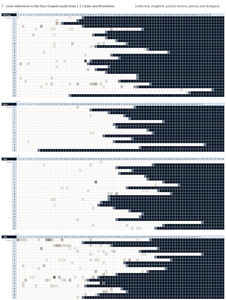
You can click on the charts to examine them more closely, and you can download them if you like. The cross references are from the NIV but there is no actual information shown in the charts so I assume we are okay with the copyright stuff.


Comments