Baptism: part 2. It's about starting, not arriving.
- May 23, 2021
- 3 min read
Updated: Feb 13, 2023
Baptism places us at the start of the path, not inside the doors of the Kingdom.
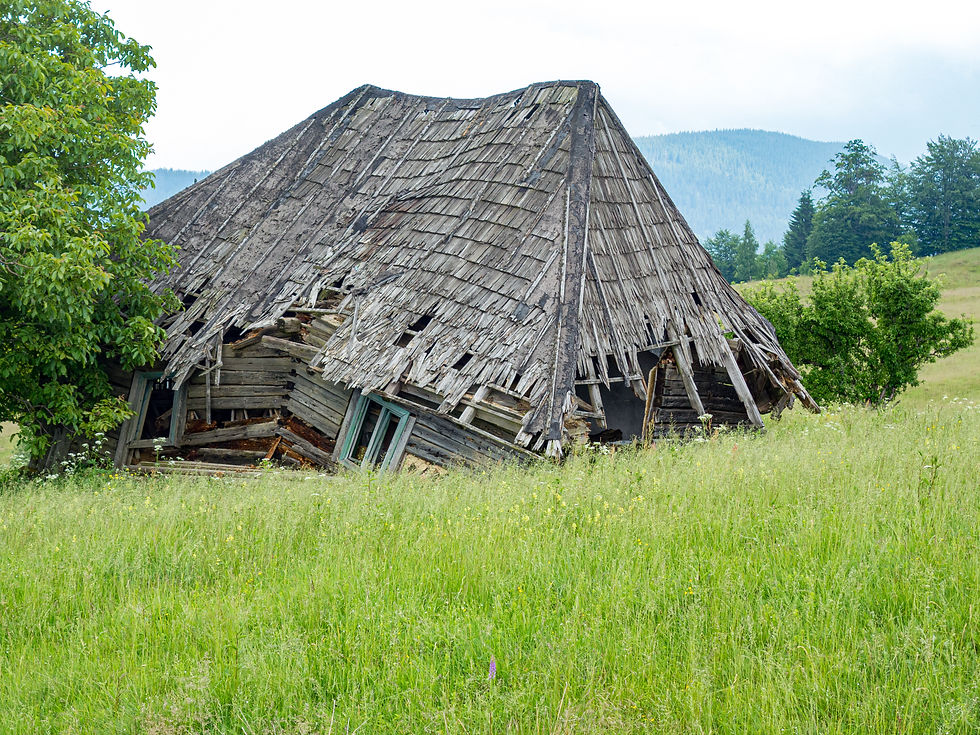
An old farm building in ruins near Baraj Drăgan
Repent, for the Kingdom of God is at hand!
When the people came to John at the Jordan they did not expect to find the Kingdom there. They understood he was talking about a different thing, and possibly a new thing, but no one expected to go down into the Jordan and come up inside the Kingdom.
When the Israelites were baptized into Moses and the Sea they were still a long way off from the Promised Land: 40 years to be precise.
Noah was on the ark 40 days before he was delivered onto dry land, and even then he was just alive: not in Paradise.
The apostles were mobbed and thrown into prison. That is not Kingdom living. The apostles baptizing people into Jesus would not have promised them a life better than theirs.
Jesus asking the disciples if they could be baptized with his baptism meant they would obey his commands at the risk of death. That is not Kingdom living.
Jesus was baptized by his death on the cross. His resurrection then delivered him back on earth, to finish his work. Nowhere does Scripture call the resurrection of Christ a baptism. If it wasn't part of his, it can't be part of ours. Romans 6:3-5:
Do you not know that all of us who were baptized into Christ Jesus were baptized into his death? Therefore we were buried with him by baptism into death, so that, just as Christ was raised from the dead by the glory of the Father, so we also might walk in newness of life.
For if we have been united with him in a death like his, we will certainly be united with him in a resurrection like his.
We were baptized into his death; we will be raised from the dead:
— Baptism has happened.
— Resurrection will happen after we die.
— Walking in newness of life is the path between the two.
If we see this correctly, many complications and confusions about baptism sort themselves out. We baptize babies to place them in a safe place. We baptize ourselves to protect ourselves until we get to heaven. Neither of these are what baptism is for.
We disagree strongly on forms of baptism because our eye is on heaven. We would not disagree so strongly if we see that baptism is about the path, not heaven. Baptism as the starting point means we don't have to squirm when our teenagers leave the church. They are leaving the path, not forsaking their salvation. That does not mean they are saved, but it does mean that when we assume baptism is the means or the proof of salvation, things often don't make sense.
Baptism being the start of the path means we can be more easygoing on who is baptized. We can baptize our babies because we are on the path and they must be with us. Noah and Moses took along their households; the apostles baptized households. It is understandable and right for the entire family to be on the path. It is not correct, however, to say we can deliver a loved one into the Kingdom through baptism.
Very important: This is not to say that we do things to please God enough to let us into heaven. It means only that baptism does not save. Baptism keeps the people of God together on the path of God, both the family by marriage and the family by marriage to Christ. Parents don't save their children but they can—with the blessing and delight of God—have their children with them on their path on God's path. The family is holy before God. Not righteous, but holy: set apart and watched over in his joy to give us the greatest happinesses of life. Paul says this in 1 Cor. 7:14:
The unbelieving husband is made holy through his wife, and the unbelieving wife is made holy through the brother. Otherwise, your children would be unclean, but as it is, they are holy.
The death of a spouse, baby, or child is an unimaginable grief. Baptism does not impose our grief upon the decision-making of God. But he has told us that he blesses the wedding, the marriage bed is holy, the family is holy, and divorce is a grievous, grievous sin.
God watches over the family. He gives us baptism to declare our devotion to him during this life: to tell him we want to be together under his watchful eye.
What decision God makes about the death of babies and children, regardless of baptism or faith of the parents, is wholly his. Marriage is until death do us part. God is until death restores everything back together.
God is good.


Comments